Flooring Made Simple is the business side of flooring and tile, with the money worked out, explained with drawings. Three guides: your costs, contracts and profit; measuring, bidding and job day; and the floors themselves, from subfloor prep to tile layout. One idea a page, each one drawn.
Real pages from all three guides. One idea a page, drawn, with the money worked out.
The Flooring Business, Bidding, Selling and Running Floors, and Floors and Tile, Drawn. 125 pages, one idea each.
The idea, the picture, the costly mistake and one line to remember. Read it in the van between floors.
Phone-sized PDFs to check at the kitchen table or on your knees in the hallway, yours to keep. Nothing to cancel.
You know how to lay a floor. Nobody taught you the money.
Most of the money a flooring business loses goes quietly: an hourly rate built from two wages, store work at a rate below your cost, three bags of leveler nobody priced. Every one of them has a page, and every page names the mistake.
The money pages: where flooring businesses lose money

A drawing is easier to take in between floors than a paragraph. That's why every page in the kit has one, and one line to keep.
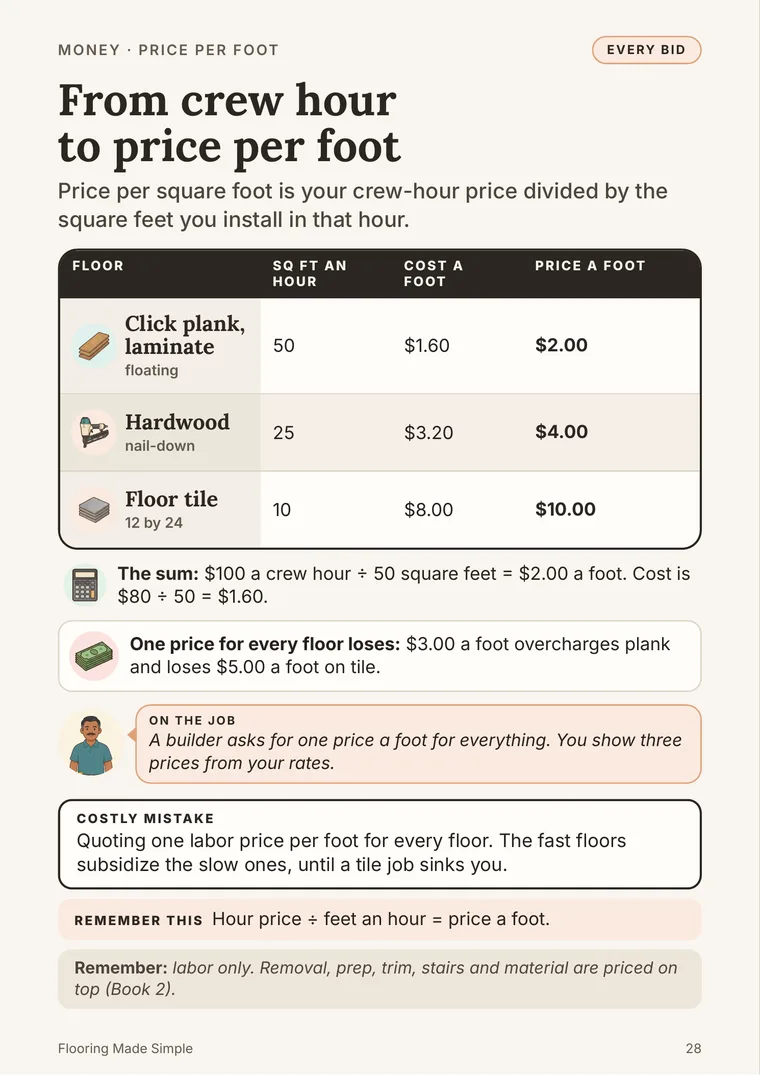
Every page has the same parts, so you always know where to look. Here is Book 1, page 28, From crew hour to price per foot, with its lines quoted from the guide.

Price per square foot is your crew-hour price divided by the square feet you install in that hour.
A builder asks for one price a foot for everything. You show three prices from your rates.
Quoting one labor price per foot for every floor. The fast floors subsidize the slow ones, until a tile job sinks you.
Hour price ÷ feet an hour = price a foot.
Quoted word for word from Book 1, page 28. The $100 crew hour and the $2.00, $4.00 and $10.00 a foot on the page are the kit's example rates, labelled as examples. Every page carries these parts plus the drawing, and where a rule changes from state to state, a note that says so.
Licenses, old-house rules, insurance, contracts, pricing, profit, taxes and crews, one idea a page. Six parts: Starting out, Insurance and bonds, Contracts, Money, Taxes, and Crews and subs. Start with what one crew hour really costs.
From the first call to the final walk, in the same layout.
The floors themselves: what's under them, the prep, and how each one goes down.
Total value: $95
One-time payment. No subscription. Keep the files forever.
Digital guides (PDF), in English. We email your library link right after purchase, and you can download the files again anytime. Plus sales tax where applicable.
Flooring Made Simple is an independent guide for people running a flooring and tile business. It explains rules in plain words and is not legal, tax, insurance or accounting advice. It is not affiliated with any licensing board, insurer or government agency.
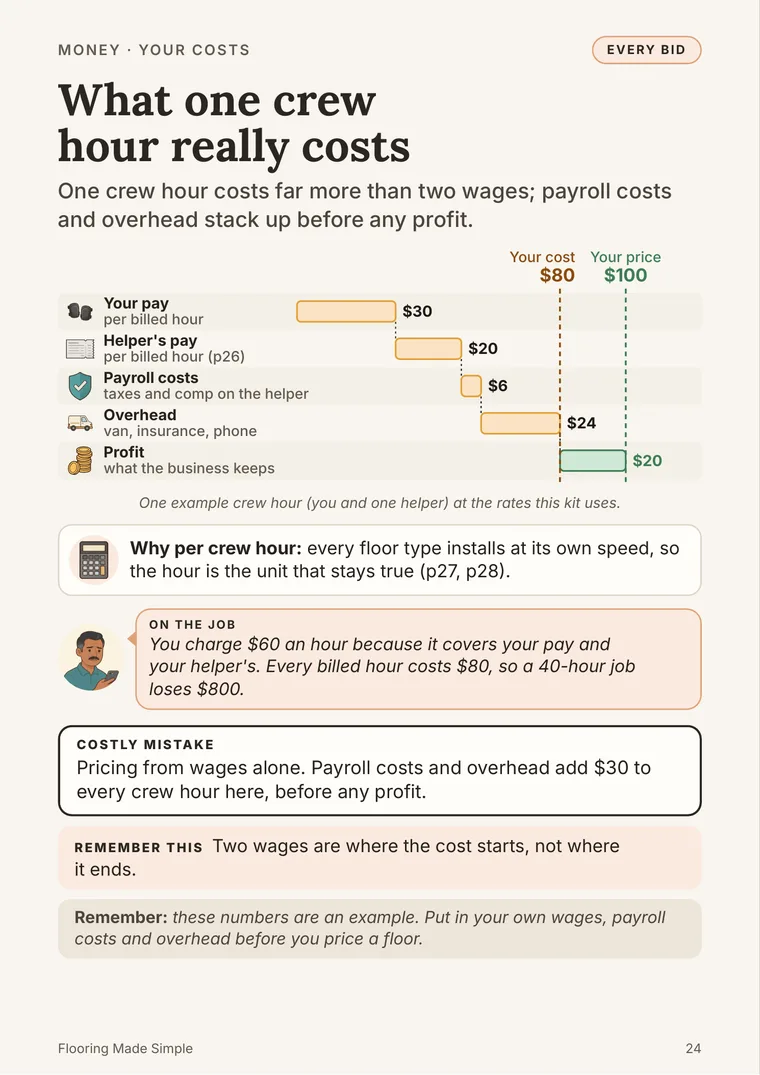
The calendar is full and the account is still thin. What one crew hour costs, overhead, price per foot, markup and margin, break-even and job costing each get a page, worked with the kit's example rates you can swap your own into.
Check the store's rate against your own cost per foot, then see how direct jobs work: the measure, the takeoff, the written bid, explaining your price and the contract that covers the prep.
You can lay a floor; the business side is new. Book 1 lays out the setup, your state's license pattern, old-house rules, insurance and comp, and the contract, then what one crew hour really costs before your first bid.
No gimmicks. Public federal rules, state statutes, industry standards and makers' installation instructions, drawn clearly, with the source named on the page where it matters.
The safety pages follow OSHA's construction rules, including silica; the old-house pages follow the EPA's lead paint and asbestos rules; the tax and 1099 pages follow IRS publications; the contract pages teach the patterns in state statutes, with any one state's rule labelled as an example; the install pages follow industry standards and the makers' published instructions. Every page was checked against its named sources before release.
Licenses, contract rules and sales tax on flooring change from state to state, and moisture limits, gaps and trowel sizes change from product to product. Those pages teach the shared pattern, label any one rule as an example, and point you to where yours lives: your state's board or your product's instructions.
The money pages work the same example rates all the way through: a crew hour that costs $80 and is priced at $100, a 20% margin, and $36,000 a year of overhead. You can see where each number comes from and swap in your own. The examples are examples, not prices for your market.
Not affiliated with or endorsed by OSHA, the EPA, the U.S. Department of Labor, the IRS, any state licensing board, any insurance company, any flooring or tile manufacturer or retailer, the National Wood Flooring Association (NWFA) or the Tile Council of North America (TCNA). We answer to the owner.
Use the kit for 7 days. If it isn't for you, email us and you get 100% of your money back. No fine print, no hassle.
Right after purchase we email you a link to your library, where you download all three guides as PDFs. You can come back and download them again anytime.
One-time payment of $27. No subscription, no recurring charges, and nothing to cancel. All three guides are yours to keep.
People running a flooring and tile business in their first few years, installers doing store installs who want their own customers, and installers about to go out on their own. The kit is built around homes: vinyl plank, laminate, hardwood and tile.
Every state. The books teach what works the same way everywhere: pricing, contracts, insurance, measuring and the install. Where a rule changes by state or city, like a contractor license, a permit or sales tax on flooring work, the page says so and shows you where to look up yours.
No. Flooring Made Simple is an independent guide for people running a flooring and tile business. It explains rules in plain words and is not legal, tax, insurance or accounting advice. It is not affiliated with any licensing board, insurer or government agency. Your lawyer, accountant, insurance agent and your state's licensing board apply the rules to your business.
No. The kit is complete on its own.

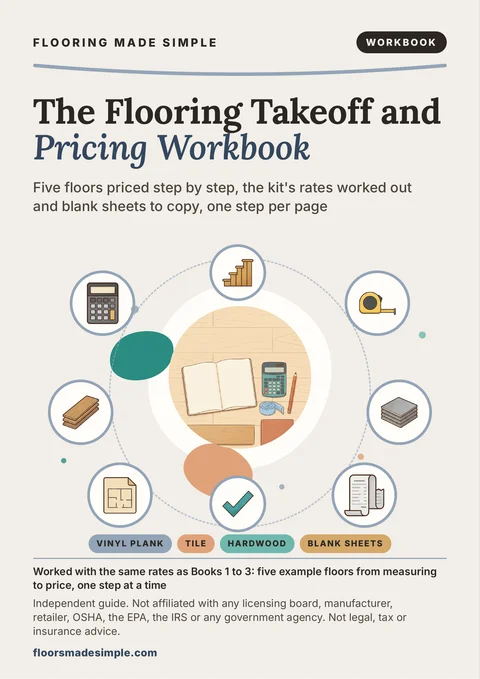
At checkout there is one optional add-on, The Flooring Takeoff and Pricing Workbook: the pricing method and your own crew-hour cost, overhead and price per square foot, five example jobs priced step by step (vinyl plank, kitchen tile, hardwood bedrooms, a retailer install and a staircase), and blank sheets to copy. It's $9, unticked, and you can skip it.
Both. The pages are portrait and phone-sized, so you can check one at the kitchen table, and the PDFs print if you want a page in the van.
We don't promise that, and we'd be wary of anyone who does. The guides show you how each piece works and the mistake that costs money, with the numbers worked on the kit's example rates. Which floors you take and what you charge is still your call.
Email us within 7 days of purchase and we'll refund 100% of your money. Details on the refund policy page.
Spotted an error, or a rule that works differently in your state or city? Email [email protected]. A real person reads every message, and fixes go into the next version.
Every month with your own crew teaches you something about the business side, and the expensive lessons come with a bill. You don't need another midnight group thread or a price per foot someone swears by. You need the page for this decision, with the money worked out and the mistake named. Built for owners who want a business that pays them back.